
Girls’ education
When girls go to school, families and communities gain: with our partner, the Kashmir Education Foundation (KEF), we support schools where girls and boys learn side by side, and a college that trains women as teachers.
Why it matters
Across Pakistan, many families want their daughters to learn, yet girls are more likely than boys to miss out on school or leave early. In its 2018 report Shall I Feed My Daughter, or Educate Her?, Human Rights Watch found that 32% of primary-school-age girls were out of school, compared with 21% of boys, and that only 13% of girls were still in school by ninth grade.
The barriers are often practical: too few schools, fewer for girls than for boys, long journeys and costs that force hard choices. Where a good school is close, safe and affordable, families choose education for their daughters as well as their sons.
Read our article on inequality in education and girls’ futures

Pupils at Pearl Valley Public School, Rawalakot.

A pupil at Soan Valley Public School, Bassali.
Girls in the schools we support
According to KEF, girls make up 49.7% of pupils at Pearl Valley Public School in Rawalakot, 31.2% at Soan Valley Public School in Bassali and 53.7% at Banjosa Valley Public School in Banjosa.
Places do not depend on a family’s ability to pay. On his visit in November 2018, our patron saw the policy of “taking in the best students who apply, regardless of their ability to afford the schooling, and giving bursaries to those who need assistance”.
Read about KEF’s aspiration for girls to take at least 51% of its places
Women trained as teachers
The Joan Atkinson College of Teacher Education (JACTE) in Bassali trains women as primary teachers through a Diploma in Primary Education. Trainees learn interactive methods that help children understand and apply what they learn, and practise in classrooms at Soan Valley Public School next door.
The college encourages young women from the villages to become primary teachers, so that they can teach in schools in their own localities and in KEF’s schools.
Find out more about the college or read why teacher training is the multiplier.
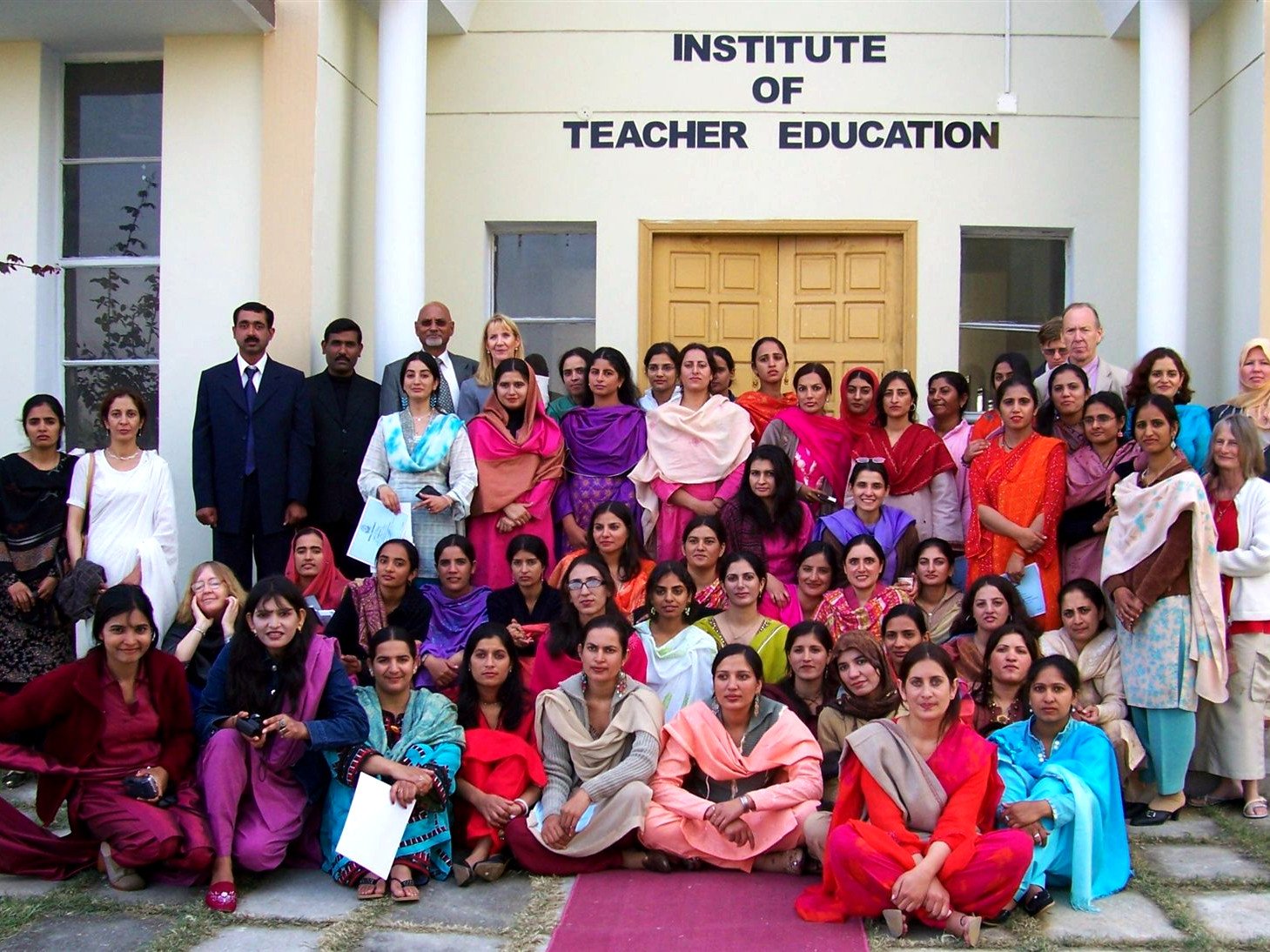
Women trainee teachers and their trainers at KEF’s teacher training institute in Bassali.

The first pupils at Banjosa Valley Public School with their teachers, March 2009.
Families choosing education
Girls’ education here is something families choose. Banjosa Valley Public School welcomed its first pupils, girls and boys together, in March 2009, and many of its pupils travel a considerable distance over difficult terrain to get there each day.
After his visit in November 2018, our patron noted that Rawalakot district had gone from “just a small handful” of schools when Pearl Valley opened to 63. He saw this as a testament to KEF, which had demonstrated the importance and benefits of quality education.
How you can help
Give to the schools and the college, or share your experience as an educator.
Give to our schools
Your donation helps keep places open for girls and boys and supports the training of women teachers.
Share your expertise
Teachers and educators can support the schools and the college with their knowledge and experience.