
Zakat and Sadaqah
How to give Zakat and Sadaqah
Zakat is an act of worship, so it matters that it reaches the people it is meant for. Here is how we handle Zakat, Sadaqah and Lillah, and how to give each one.
Obligatory
Zakat
Zakat is handled separately from all other gifts and is meant only for eligible people. You can give once or every month through our Zakat-only JustGiving checkouts, or by bank transfer using the reference Zakat (our account details are in the FAQ). JustGiving may invite you to add an optional contribution to its own costs; the amount, if any, is your choice.
Please read how KEF applies Zakat, further down this page, before you give.
Voluntary
Sadaqah Jariyah and Lillah
Voluntary gifts can fund any part of the work: classrooms, teacher training, salaries and running costs. A school keeps giving for generations, which makes it a natural Sadaqah Jariyah.
How we use Zakat
QEF keeps Zakat separate from all other gifts, records how much has been collected and tells KEF the amount. KEF applies it as concessions on fees, and for trainee teachers on hostel and meals, for eligible pupils at its schools and eligible trainees at the Joan Atkinson College of Teacher Education. KEF checks that each recipient is Muslim, is not a Sayyid and comes from a household below the nisab threshold.
QEF takes no costs from Zakat. Gift Aid claimed on Zakat given through our Zakat-only JustGiving checkouts is added to the Zakat and used in the same way. Zakat is not used directly for buildings, salaries, running costs, fundraising or administration. These are funded by Sadaqah and general donations.
Zakat is applied to
- Fee concessions for eligible pupils
- Fee, hostel and meal concessions for eligible trainee teachers
Zakat is not used for
- Building or maintaining classrooms
- Teachers’ and staff salaries
- Running costs, fundraising or administration
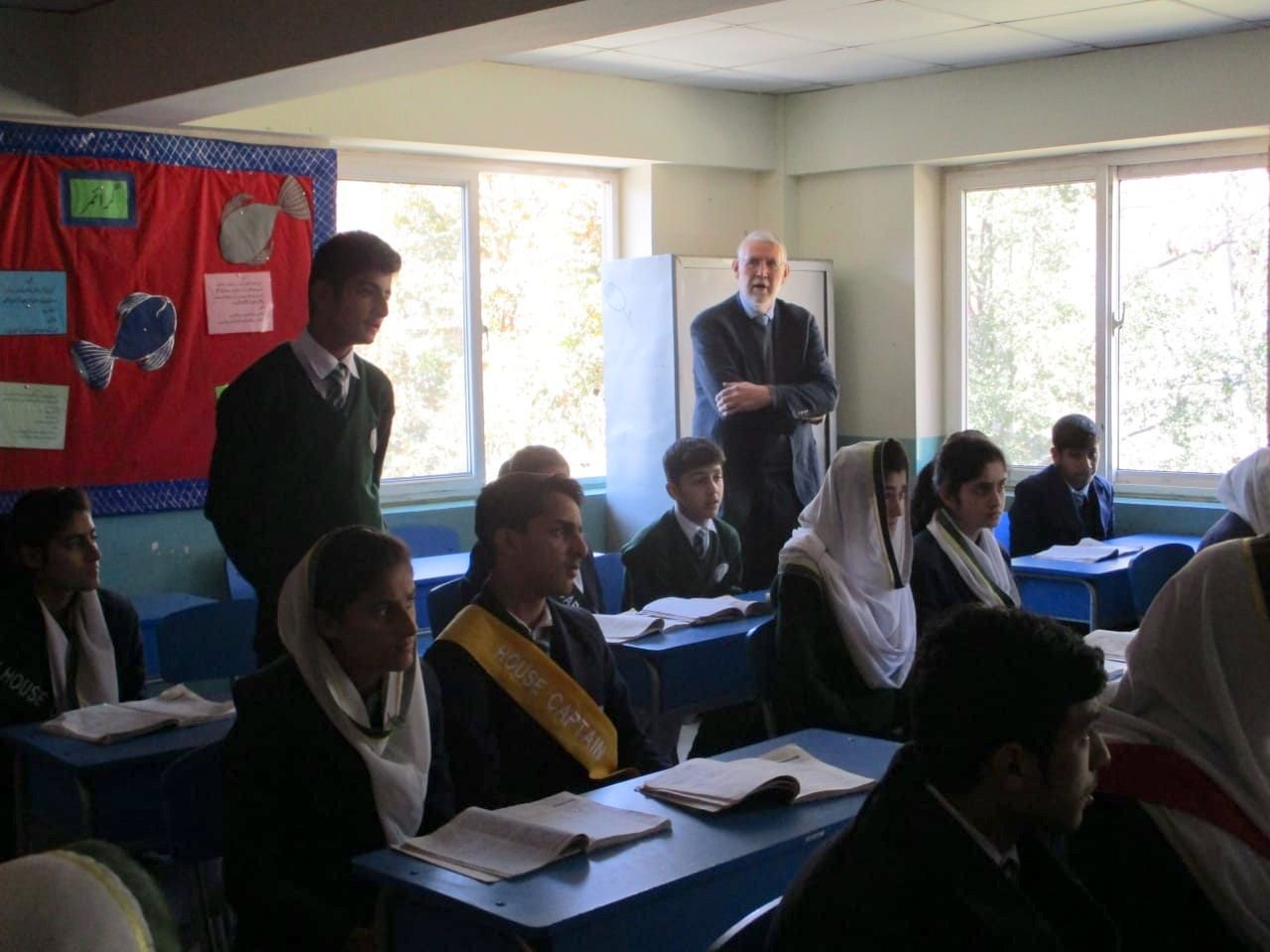
Sir David Green meets a senior class at Banjosa Valley Public School, November 2018.

The front of Soan Valley Public School, Bassali.
Zakat in the Hanafi school
Most of our supporters follow the Hanafi school, so this page follows Hanafi guidance on who may receive Zakat and how.
Who is eligible
Zakat is for the poor and the needy (Qur’an 9:60), who must be Muslim. In the Hanafi school, families of the Banu Hashim do not receive Zakat; they can be helped through Sadaqah. Eligibility is assessed for each household: a family whose zakatable wealth is below the nisab, with no surplus non-essential assets, may be eligible. A child whose father is wealthy is not eligible, while an orphan or the child of a poor father may be. So not every pupil at a school is eligible for Zakat.
Ownership (tamlik)
Tamlik means that ownership of the Zakat passes to the eligible person, or to the parent or guardian of a young child, directly or through an agent acting with their consent. Many Hanafi scholars require this, and do not accept that waiving a fee, providing a service or cancelling a debt fulfils Zakat.
How KEF applies Zakat
KEF applies Zakat as concessions on fees, hostel and meals, rather than paying it to each recipient. Many Hanafi scholars hold that concessions of this kind do not meet the requirement of ownership. QEF is not a scholarly body, and we do not claim that any scholar has approved this approach. If you want certainty, please ask a scholar you trust before you give Zakat. Sadaqah Jariyah and Lillah have no such conditions and can fund any part of the work.
Why Zakat can go to Pakistan
Scholars generally encourage giving Zakat locally. The Hanafi school permits sending it abroad where the need is greater, and dislikes moving it only where there is no such reason.
The schools and the college we support serve rural communities in Pakistan and Azad Jammu and Kashmir, where the nearest good school was once hours away.
Do you need to pay Zakat?
Zakat is due on zakatable wealth above the nisab threshold that you have held for a lunar year. Many Hanafi scholars recommend using the silver nisab.
The National Zakat Foundation publishes the current nisab and a calculator. Check the current nisab on the National Zakat Foundation website.
Sadaqah Jariyah and Lillah
The Prophet Muhammad (peace be upon him) said: “When a man dies, his acts come to an end, but three, recurring charity, or knowledge (by which people) benefit, or a pious son, who prays for him (for the deceased).”
Sadaqah is voluntary charity. It can fund any good purpose and can benefit anyone. Sadaqah Jariyah is ongoing charity whose benefit continues over time. Lillah is a voluntary gift for a cause, often an institution such as a school.
Your Sadaqah Jariyah helps build and maintain classrooms, train teachers and keep schools open, so every new class of children benefits from your gift.

The front of Banjosa Valley Public School.
Common questions
Zakat al-Fitr and Fidyah
We do not accept Zakat al-Fitr or Fidyah.
Can I give Zakat online?
Yes, but not through the general donation checkout, which cannot keep Zakat separate. Please use one of our Zakat-only JustGiving checkouts: Zakat, one-off payment or Zakat, regular monthly payment. You can also pay by bank transfer using the reference Zakat. JustGiving may invite you to add an optional contribution to its own costs; the amount, if any, is your choice.
What is the difference between Zakat and Sadaqah?
Zakat is an obligation on eligible wealth and may go only to eligible recipients, such as the poor and the needy. Sadaqah is voluntary, can fund any good purpose and can benefit anyone. Sadaqah Jariyah is Sadaqah whose benefit continues, such as a school or a trained teacher.
Is every pupil eligible for Zakat?
No. In the Hanafi school, eligibility depends on the household. A child whose father is wealthy is not eligible; an orphan or the child of a poor father may be.
Can Zakat pay for school buildings or teachers?
No. Buildings, salaries and running costs are funded by Sadaqah, Lillah and general donations. If you would like to support them, please give Sadaqah Jariyah.
How do I know how much Zakat I owe?
Zakat is usually 2.5% of zakatable wealth held above the nisab for a lunar year. The National Zakat Foundation publishes the current nisab and a calculator. If you are unsure, please ask a scholar you trust.
Can I add Gift Aid?
If you are a UK taxpayer, Gift Aid lets us claim an extra 25p for every £1 you give, at no extra cost to you. You must pay at least as much UK Income Tax and/or Capital Gains Tax in the tax year as all the charities you give to will claim; if you pay less, you are responsible for the difference. Gift Aid claimed on Zakat given through our Zakat-only JustGiving checkouts is added to the Zakat and used in the same way.
Give Zakat
Give once or monthly through a Zakat-only checkout, or pay by bank transfer with the reference Zakat.